
The best way to memorize the organic chemistry reactions
Struggling to get the organic chemistry reactions to stick in your brain? This summary can help. Use it to prepare for your matric exams.

From struggle to solution in organic reactions
I remember struggling (with a capital S) to understand grade 12 organic chemistry reactions. Naturally, when I started helping matric students, I could not let them suffer the way that I did. What I needed to do next became obvious. I needed to design a comprehensive guide that makes every matric student’s life easier; a guide that not only concisely summarizes all the organic chemistry reactions, but also highlights important reaction conditions and rules.
What you need to know about the organic reactions
Before you download this handy guide, let’s have a quick chat about what’s expected of you in an exam under the organic reaction section. The Curriculum Assessment Policy Statement (CAPS) requires matric students to:
- Identify organic reactions as addition, elimination or substitution
- Write down, using structural and condensed formula, equations and reaction conditions for addition, elimination and substitution reactions
- Identify minor and major products of organic reactions by applying Markovnikov’s addition rule and Zaitzev’s elimination rule (You might be thinking, “Ma’am, are you making this up?” The answer is: no.)
It’s okay if this sounded a bit foreign to you, because I’ll elaborate on each point.
Identifying the types of organic reactions
There are three broad categories of organic reactions: addition, elimination and substitution. These may also be referred to as the “general type” of reaction (nudges my students writing the IEB exams). To no one’s surprise, addition reactions are organic reactions in which atoms are added to an unsaturated compound; elimination reactions involve the removal of atoms from a saturated compound; and substitution reactions occur when an atom in a molecule is replaced by another. Mind = blown.
Representing organic reactions
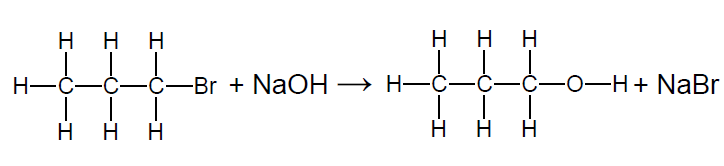
Not only do you need to identify the different types of reactions, but you also have to represent them using balanced equations. In fact, I’d bet my bottom dollar that a question requiring you to represent an organic reaction using structural or condensed formula makes an appearance in your mock and final exams. Now you see how serious this is. Structural formulas are visual representations of organic compounds, where every bond is illustrated as a line connecting atoms. In contrast, condensed formulas depict compounds in a text form without any bonds drawn. The diagrams below highlight the key differences between representing organic reactions with structural vs. condensed formulas.
Hydrolysis reaction represented with structural formulas:
Hydrohalogenation reaction represented with condensed formulas:

Major and minor products of organic reactions
Markovnikov’s addition rule? Zaitzev’s elimination rule? Who are these Russian divas, and why are they ruining your life? All valid questions. For now, let’s focus on how these rules help us predict the major and minor products in organic reactions. Organic reactions often form a mixture of products i.e. the major product forms when the reaction follows the rules, and minor product forms when it doesn’t. Markovnikov’s rule tells us that the hydrogen atom aads to the carbon that already has the most hydrogen atoms directly bonded to it (the rich get richer, if you will). Zaitzev’s rule, on the other hand, tells us that hydrogen is eliminated from the carbon that has the fewest hydrogen atoms directly bonded to it. This is a watered-down version of the rules for matric-level organic chemistry – no need to complicate something that can be explained simply, right?
Markovnikov’s addition rule during hydrohalogenation:
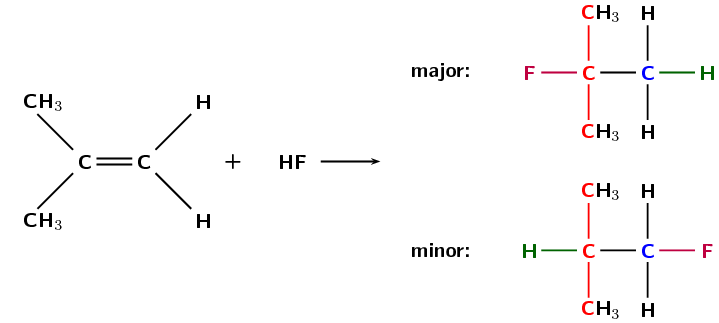
The hydrohalogenation of 2-methylpropene to form 2-fluoro-2-methylpropane (major product) and 1-fluoro-2-methylpropane (minor product), Siyavula
Zaitzev’s elimination rule during dehydration:
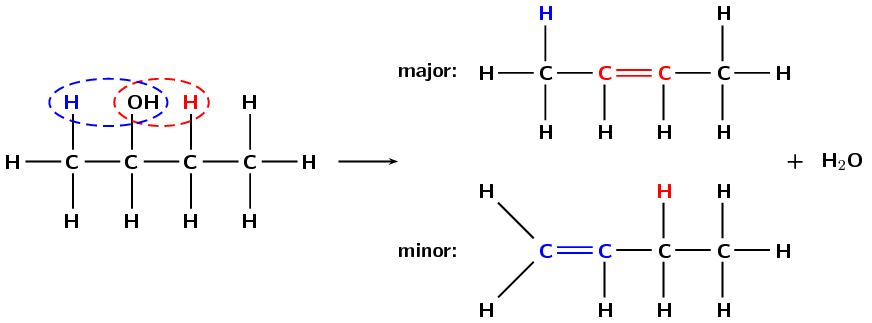
The dehydrohalogenation of 2-bromobutane to form but-2-ene (major product) and but-1-ene (minor product), Siyavula
Your free organic chemistry reactions summary is waiting . . .
To do all of the above effectively, there’s a substantial amount of information you need to get into your brain. As you can imagine, it really helps having an overview of the entire topic in a single document. While this guide is a game-changer, it won’t work unless you do. My intention in creating this summary was to give you a document that guides you while you work on past paper questions. You can easily flip through the document to help you identify the different reactions, reaction conditions and rules. Keep your copy close while practicing past paper questions and soon you won’t even need to refer to it because you’ll already know your work.
